Introduction: The Unplugging
You know the feeling. That phantom buzz in your pocket, the endless, thumb-scrolling trance, the quiet hum of anxiety from a world you can’t possibly keep up with. One day, I just stopped. I didn’t make a grand announcement or deactivate my accounts in a blaze of drama. Instead, I put the apps in a folder, turned off notifications, and decided to step into the quiet. I was desperate for a break, but what I found was a revelation.
This wasn’t just about reducing screen time; it was an unexpected expedition into my own mind. I thought I was just giving my eyes a rest, but in reality, I was giving myself a voice. What followed was a series of startling, beautiful, and sometimes uncomfortable truths about who I am when I’m not performing, consuming, or comparing. The social media break benefits I experienced were far more profound than simple digital minimalism. They were lessons in humanity.
Section 1: The Rediscovery of Uninterrupted Thought
The Symphony in Your Own Head
Before the break, my mental landscape resembled a crowded, noisy stock exchange. Thoughts were fleeting fragments—a reaction to a post, a mental draft of a caption, a ping-pong of opinions. My brain had become a terminal for processing inputs, not a workshop for generating original ideas. Silence was something to be filled, immediately, with another hit of digital content.
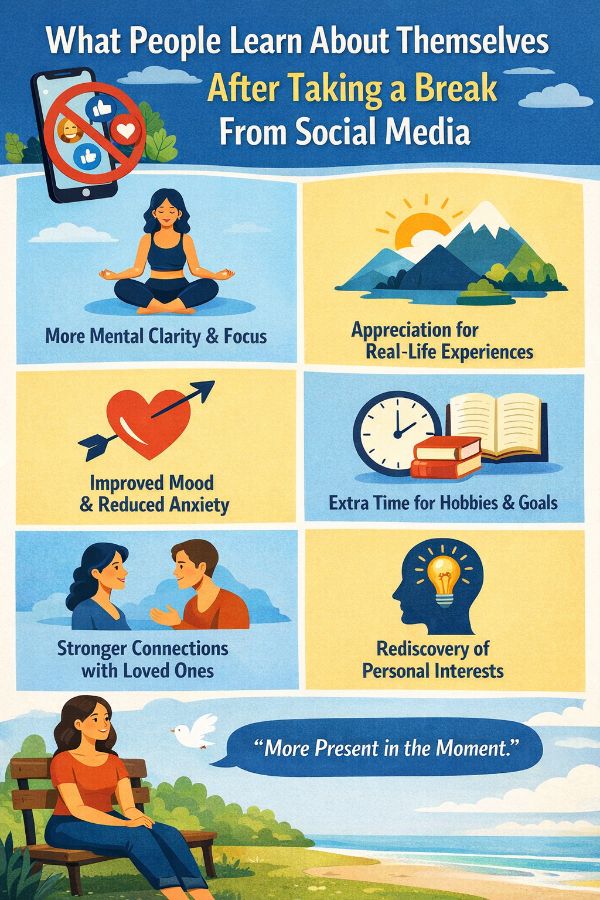
Then, the quiet came. At first, it was unnerving. I’d reach for my phone out of habit and find nothing but a blank screen. But soon, a marvelous thing happened. My thoughts, no longer interrupted every 90 seconds, began to form complete sentences. They started to link together, creating chains of logic, memory, and creativity I forgot I possessed. I began thinking through things, rather than around them. This mental clarity is, without a doubt, one of the most underestimated social media break benefits. You remember you have an inner narrator, a consciousness that is curious and deep, and it’s been waiting patiently for you to stop scrolling and start listening.
Section 2: The Fading Echo of Comparison
When the Mirror Stops Talking Back
Social media is the world’s most exhaustive highlight reel, and we are all unwilling curators of our own perceived inadequacies. We constantly measure our behind-the-scenes against everyone else’s premiere. This relentless comparison is a thief of joy, but you often don’t realize how deeply it has embedded itself into your psyche until you step away.
Without the daily drip-feed of curated perfection, the internal critic begins to lose its fuel. The urgency to have the photogenic hobby, the picture-perfect home, or the enviable vacation simply evaporates. You start to appreciate your coffee for its taste, not its potential as a prop. You enjoy a walk for the sun on your face, not for the step count you’ll post. The liberation from this invisible race is staggering. You learn that your worth is not a metric to be validated by likes, but a quiet, inherent fact. Your life, in all its messy, ordinary glory, is enough.
Section 3: The Astonishing Gift of Time Reclaimed
Where Did All These Hours Come From?
Let’s be brutally honest: social media is a time vampire. We snack on it throughout the day, convincing ourselves it’s just a minute, only to look up and find an hour has vanished into the void. We speak of being “busy,” yet we donate massive chunks of our finite lives to passive scrolling. After deleting the apps, I experienced a sudden, almost comical surplus of time.
This newfound time felt expansive and rich. I didn’t immediately fill it with hyper-productivity. Instead, I spent the first week simply being bored—a sensation that felt strangely luxurious. Then, organically, I started reading books that had gathered dust. I cooked elaborate meals. I called my parents. I sat on my porch and watched the birds. The lesson was clear: the “busy” we often lament is frequently a choice, a filler for spaces we’re afraid to leave empty. When you reclaim those hours, you learn what you truly enjoy when no one is watching.
Section 4: The Depth of Real-World Connection
The Texture of a Real Conversation
Digital connection is wide but shallow. It’s a vast ocean you skim across at high speed. During my break, I craved depth. I started making actual plans with friends, looking them in the eye, and hearing the full spectrum of their voice—not just the tone of a text message. Conversations meandered. There were pauses, laughs that lasted too long, and stories that unfolded without the pressure of being entertaining enough for an audience.
Consequently, I learned that my capacity for empathy and attention had been dulled by the digital noise. I was a better listener. I asked follow-up questions. I noticed body language. The relationships in my immediate, physical world became richer and more nuanced. This reinforced one of the key social media break benefits: it doesn’t make you antisocial; it often makes you more sociable in the ways that truly nourish the human spirit. You remember that connection is a shared experience, not a broadcast.
Section 5: The Body’s Quiet Signals
Your Shoulders Will Thank You
We frame digital detox in mental terms, but the physical revelation is just as potent. I hadn’t connected my chronic neck stiffness, my shallow breathing, or my disrupted sleep to my online habits. I was living in a state of low-grade, screen-induced fight-or-flight. The constant engagement, the argumentative comments, the bright blue light—my body was keeping score.
Within a week of my break, my sleep became deeper and more restorative. The tension in my jaw, which I hadn’t even consciously noted, disappeared. I felt less frazzled and more physically present. I started noticing real-world sensations more acutely: the feel of a breeze, the taste of food, the fatigue of a good day’s work. You learn that your body is constantly communicating its needs, and social media often turns the volume down on those signals until they become a shout of pain or exhaustion.
Section 6: The Evolution of Your Own Opinions
Who Thinks These Thoughts, Anyway?
In the algorithmic echo chamber, opinions are often formed reactively. We read a headline, scan the hottest takes, and align ourselves with a camp. Our worldview can become a patchwork of absorbed sentiments, not deeply held convictions. During my time offline, I encountered ideas in a new way—through books, long-form articles, and in-person debates.
The process was slower and more thoughtful. I discovered that without the pressure to immediately have a “take” or to perform my stance for followers, my opinions became more nuanced, more flexible, and more truly my own. I could sit with ambiguity. I could change my mind without the social capital penalty of an edited tweet. This intellectual autonomy was a profound discovery. It highlighted that one of the critical social media break benefits is the space to develop a belief system that is internally validated, not externally performed.
Section 7: The Rekindling of Authentic Boredom and Creativity
The Fertile Void
Our culture pathologizes boredom. We see it as a problem to be solved with our phones. However, boredom is not the enemy; it is the fertile ground from which creativity sprouts. When I removed the easy escape of endless content, I was forced to confront empty moments. I stared out windows. I doodled on napkins. I actually listened to a full album from start to finish.
From this void, small creative impulses began to emerge. I started writing in a journal, not for content, but for clarity. I tinkered with projects around the house. I played music. Boredom became a gateway, not a prison. I learned that my creative self hadn’t abandoned me; it had just been drowned out by the constant noise. Creativity needs idle time to incubate, and social media is the ultimate incubator killer.
Section 8: The Shift from Consumption to Creation
From Audience to Author
The default mode on social platforms is consumption. We are the audience for everyone else’s life, work, and ideas. This passive role can subtly erode our sense of agency. We become critics and curators of others’ output instead of generating our own. After my break, the balance began to shift. With my mental space cleared, I felt a natural push to make things.
I cooked instead of watching cooking videos. I started a small garden instead of browsing garden aesthetics. I wrote for myself. The act of creation, however small, rebuilds a sense of personal authority and accomplishment. You learn that you are not just here to observe and react, but to contribute something tangible to your own life. The energy you once spent absorbing is now available for generating, which is a deeply empowering transition.
Conclusion: The Choice to Return (Or Not)
Carrying the Quiet Back With You
My social media break wasn’t permanent. I did return, but I returned differently, armed with the lessons of the quiet. The social media break benefits had rewritten my user manual. Now, I use the platforms with intention, not compulsion. I’ve left most notifications off. I curate my feeds aggressively. I put the apps away for large portions of the day. Most importantly, I now know the difference between the simulated world and the real one, and I prioritize the latter.
The ultimate learning was this: I am not my profile. My value, thoughts, time, and attention are my most precious assets. A break from social media isn’t an act of rejection; it’s an act of reclamation. It’s the quiet rebellion of choosing yourself over the feed. And in that silence, you might just hear the person you’ve been all along, patiently waiting for you to look up.