
Quick Answer: A travel pack of incense is a small set of short incense sticks, sometimes with a compact holder, made to fit in a bag. It can be a pleasant way to make a hotel room or campsite feel more like your own, but it is a naked flame, so the rules matter more than the scent. Never leave it burning unattended, always use a heat-resistant holder on a stable surface, check the hotel or campsite rules first, and skip it entirely if anyone nearby has asthma or a smoke sensitivity.
Incense has been part of daily rituals for centuries, from temples to living rooms. A travel pack is simply that habit made portable: a few sticks in a slim box or tin, light enough to forget about until you want it. What follows is a practical guide to using one well, and to the mistakes that turn a small pleasure into a problem.
What a travel pack actually is
Most travel packs contain short incense sticks, usually half the length of a standard stick, in a flat box or metal tin. Some include a small holder, often a folding wooden one or a metal dish, and a few come with a short burn time by design. The sticks are the same thing as ordinary incense: a paste of aromatic wood, resin and oils pressed onto a thin bamboo core, or formed without a core at all.
The difference from a home pack is size, not magic. Shorter sticks burn for less time and produce less smoke, which is exactly what you want in a small room. When you buy one, check whether a holder is included. A stick balanced in a glass or wedged into a crack is how accidents happen.
Choosing a scent without overthinking it
Sandalwood, cedarwood, lavender and frankincense are the usual choices, and they are usual for a reason: they are woody, warm and not too sharp in a small space. Floral scents such as rose or jasmine can feel heavy in a hotel room, and very sweet scents can clash with food at dinner.
It is worth being honest about what incense can and cannot do. It will not make you calmer, more spiritual or more creative. It can make a strange room smell familiar, and that familiarity is genuinely comforting after a long day of travel. That is enough. Anyone promising that a scent will lift your mood or heal anything is selling you something.
Packing it so it survives the trip
Incense sticks snap easily, so keep them in their box or a rigid tube, and pack them where they will not be crushed. If you are flying, remember that the sticks themselves are fine in a bag, but a lighter is not. Under UK rules you may carry one lighter on board, kept in a resealable plastic bag on your person for the whole flight, and you cannot put one in hold luggage. The GOV.UK hand luggage guidance sets out the current rules, and they can differ on the way home, so check your airline and destination airport before you travel.
Matches are simpler: a small box of safety matches can usually be carried on your person, but strike-anywhere matches are not allowed. Either way, do not pack a lighter in your suitcase and hope for the best. Security will take it, and you will have lost it for nothing.
Using it safely, wherever you are
This is the part that matters most. Incense sticks, candles and oil burners are among the most common causes of fires in homes, and the London Fire Brigade’s advice is blunt: never leave them unattended, always put them out when you leave the room and especially before bed, and keep them in a heat-resistant holder on a stable surface, away from curtains, papers, furniture and clothes. Their candle and incense safety page covers exactly this, and it is worth reading before you light anything in a place you do not know.
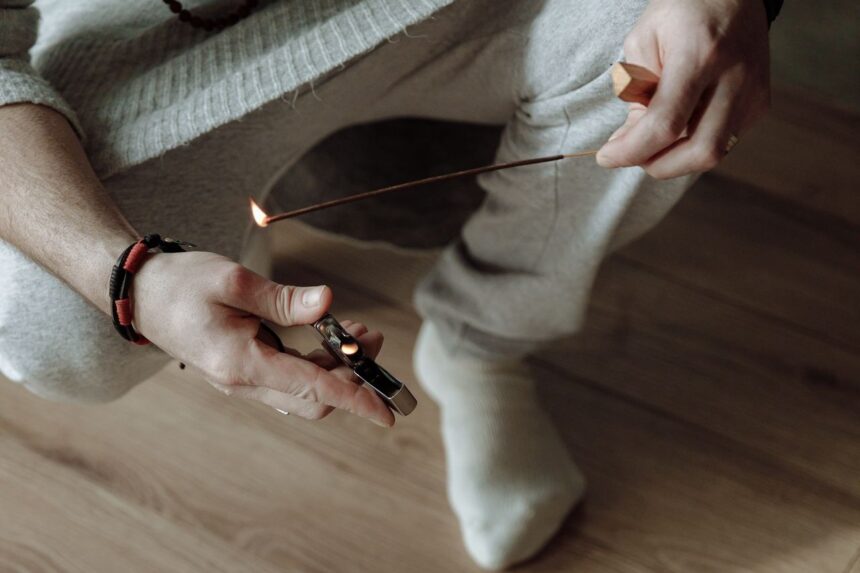
A few practical rules follow from that. Light the stick, let the flame catch, blow it out and let it smoulder. Keep it away from bedding and curtains. Never burn incense in a tent: a tent is fabric, a stick is a naked flame, and the combination needs no further explanation. Ventilate the room by opening a window a little, both so the smoke has somewhere to go and so the room does not fill up. And if the smoke alarm goes off, do not be annoyed with the alarm. It is doing its job.
Hotels and Airbnbs deserve a special mention. Many ban incense and candles outright, and breaking that rule can mean a fine or a cleaning charge. Ask first, or check the house rules. If the answer is no, accept it. A scented sachet or a dab of essential oil on a cloth gives you the smell without the flame.
When to skip it
Incense smoke is smoke, and some people should not be around it. If you have asthma or another breathing condition, or if anyone sharing the room does, do not burn incense indoors. The same applies in shared spaces such as hostels and dorm rooms: your ritual is someone else’s irritation. Outdoors, keep it away from dry grass and leaves, and only burn it where open flames are allowed. A campsite that bans campfires bans your incense too.
None of this is meant to put you off. Used with a little care, a travel pack of incense is a small, cheap way to make a strange place feel like yours for an evening. The trick is to treat it like what it is: a tiny fire, not a scented candle with ambitions.
Frequently Asked Questions
Can I take incense sticks on a plane?
Yes, incense sticks themselves are fine in your luggage. The lighter is the tricky part: under UK rules you may carry one lighter on board, kept in a resealable plastic bag on your person for the whole flight, and you cannot put one in hold luggage. Check your airline and destination airport, as rules can differ on the return journey.
How long does one incense stick burn for?
It depends on the stick. A standard full-length stick often burns for around 30 to 60 minutes, while the short sticks in travel packs are usually done much sooner. The pack should state a burn time, and if it does not, assume a short stick will last roughly 20 to 30 minutes.
Can I burn incense in a hotel room?
Only if the hotel allows it, and many do not. Check the house rules or ask at reception first, as burning incense against the rules can mean a fine or a cleaning charge. If it is not allowed, a scented sachet gives you the smell without the flame.
Is incense smoke safe to breathe?
Incense smoke is still smoke, so ventilate the room and do not burn it around people with asthma or other breathing conditions. If you have a respiratory condition yourself, or you are unsure, it is safer to skip it and use a flameless option instead.