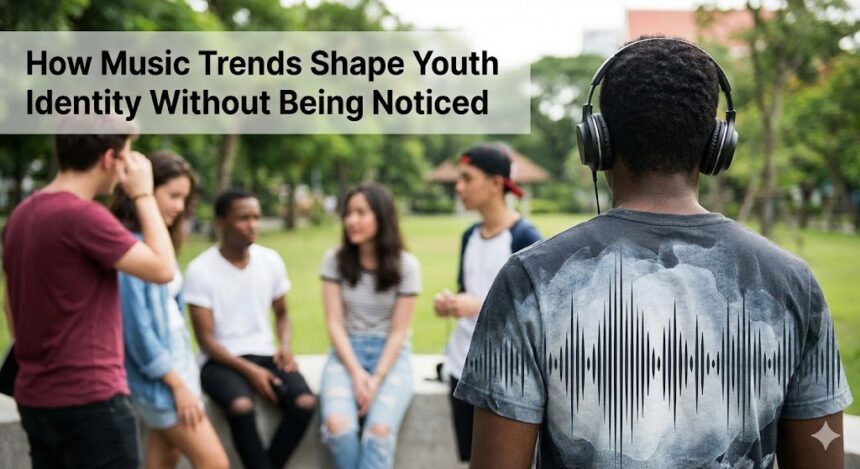
We often think of music as entertainment, a background score to our lives, or a momentary escape. For young people, however, music is far more profound. It is a silent architect, a subconscious cartographer mapping the contours of identity, belonging, and belief. The trends that dominate the charts, streaming platforms, and social media feeds do more than define a generation’s sound; they subtly and powerfully shape a generation’s sense of self. This process operates not through loud declaration, but through stealthy, pervasive influence, leveraging deep principles of music psychology to mold youth identity often without being noticed.
This article delves into the mechanisms behind this phenomenon, exploring how the fusion of sound, community, and technology guides young individuals in answering life’s fundamental questions: Who am I? Where do I belong? What do I believe?
The Psychological Soundtrack: How Music Embeds Itself in the Mind
At its core, the relationship between music and identity is rooted in the science of music psychology. This field examines how our brains process sound and why it evokes such powerful emotional and behavioral responses. For adolescents and young adults, whose brains are in a critical period of neuroplasticity and social development, these effects are amplified.
The Neurological Hook: More Than Just a Feeling
When a young person listens to music they connect with, their brain undergoes a complex symphony of activity:
-
Dopamine Release: The mesolimbic pathway, the brain’s reward circuit, is activated. This is the same system engaged by food, social interaction, and other pleasurable stimuli. It creates a sense of pleasure and reward, forging a positive, subconscious association with the music and, by extension, the identity cues within it.
-
Memory Encoding: Music is deeply tied to the hippocampus, the brain’s center for long-term memory. This is why a song can instantly transport you back to a specific time, place, and feeling. For youth, the music of their formative years becomes the autobiographical soundtrack of their identity formation.
-
Emotional Processing: Music bypasses the neocortex (the rational, analytical part of the brain) and directly stimulates the amygdala and limbic system, which govern emotion. This allows music to evoke and validate feelings—anger, joy, sadness, rebellion—that a young person might still be learning to articulate.
The Subconscious Language of Sound and Lyrics
Music trends communicate a hidden language of values and attitudes. A driving, distorted guitar riff subconsciously signals rebellion and intensity. A sparse, synth-based trap beat might convey urban cool, melancholy, or minimalist ambition. The lyrical themes of a popular genre—whether it’s the vulnerable confessionals of modern pop, the gritty narratives of drill, or the aspirational flexing of hip-hop—provide a script. Young listeners don’t just hear these scripts; they internalize them as frameworks for understanding their own experiences, struggles, and aspirations.
The Invisible Blueprint: How Trends Forge Identity
Music trends act as a cultural blueprint, offering pre-fabricated but customizable modules for building an identity. This process is rarely a conscious choice (“I will listen to this to become X”). Instead, it’s a gradual alignment.
1. Tribal Affiliation and the Need to Belong
The primary function of music trends for youth is signaling group membership. In an era where traditional community structures have weakened, musical subcultures (and their digital counterparts) provide instant belonging.
-
Symbolic Uniforms: Genre allegiance often comes with stylistic cues—fashion, slang, even posture and attitude. A fan of indie rock might adopt a different aesthetic from a K-pop fan or a devoted listener of UK garage. These are outward badges of an inward identity.
-
Digital Tribes: Online, this is magnified. Algorithms on Spotify or TikTok create “vibe-based” communities. Sharing a niche playlist or a deep-cut track on social media is a powerful act of social signaling, creating micro-tribes with specific identities.
2. Value Systems and Worldview Formation
The narratives within trending music subtly impart value systems. Consider the evolution of popular genres:
| Music Trend / Era | Potential Embedded Values & Identity Cues |
|---|---|
| 1990s Grunge | Authenticity over polish, cynicism towards mainstream, introspection, apathy as a posture. |
| 2000s Hip-Hop & R&B | Aspiration, resilience, material success as a symbol of overcoming, confidence, storytelling. |
| 2010s EDM/Festival Culture | Collective experience, hedonism, euphoria, escape, global citizenship. |
| Current Hyperpop / Bedroom Pop | Digital-native identity, genre fluidity, emotional rawness, DIY ethos, queerness, and alienation. |
A young person immersed in a trend absorbs these value-laden narratives, which shape their perspectives on success, relationships, society, and self-expression.
3. The Scaffolding for Personal Identity
Beyond the tribe, music provides tools for crafting a unique self. This is where music psychology shows its intimate face.
-
Self-Concept Validation: When a lyric perfectly describes a nebulous feeling, it provides validation. It tells the listener, “You are not alone. Your feeling is real and has a name.” This helps solidify a young person’s understanding of their own emotional landscape.
-
Emotional Regulation: Youth use music deliberately as a tool for mood management—an upbeat playlist for motivation, a sad playlist for catharsis. This practice teaches them to use external cultural artifacts to regulate internal states, a key part of identity development.
-
The “Possibility Model”: Artists and their personas serve as templates. A young person might see aspects of their desired self—confidence, creativity, resilience—in a musician and begin to emulate those traits, consciously or not.
The Unnoticed Mechanisms: How Influence Flows Under the Radar
The shaping of identity is so effective precisely because it goes unnoticed. Here’s how the influence operates in stealth mode:
-
Ambient Social Soundtrack: Music is often consumed in social settings—parties, commutes with friends, shared headphones. The associations formed are not just with the music, but with the social bonding it facilitates. The identity becomes linked to cherished memories of belonging.
-
Algorithmic Curation: Young people rarely sift through a neutral universe of sound. Algorithms learn their preferences and continuously feed them more of the same, creating a sonic echo chamber that reinforces a particular worldview and aesthetic identity, making it feel like a natural, organic extension of self rather than a curated influence.
-
Memeification and Cultural Osmosis: Musical snippets, dances, and lyrical hooks spread as memes on TikTok and Instagram. Even a young person not actively seeking out a trend will absorb its signature elements through cultural osmosis, normalizing its associated attitudes and styles.
The Double-Edged Sword: Implications of Subconscious Shaping
This unseen influence is not inherently good or bad, but it carries significant implications that educators, parents, and young people themselves should be aware of.
-
Positive Potential: Music trends can foster global connectivity, empathy across cultures, and provide a safe outlet for exploring complex emotions. They can empower marginalized youth by giving voice to their experiences and creating communities of support. Research from reputable institutions like the University of Oxford has explored how music fosters social bonding and collective emotion, which can be a powerful force for positive group identity (link: https://www.ox.ac.uk/news/2019-01-25-music-moves-us-more-powerfully-we-think).
-
Potential Risks: The uncritical absorption of values can be problematic. Trends that glorify materialism, misogyny, or violence can normalize these attitudes. Furthermore, the pressure to conform to a trend’s associated identity can stifle genuine individual exploration. As noted by the National Institute of Mental Health, adolescence is a peak time for the onset of mental health issues, and the emotions music engages are deeply tied to this vulnerable period (link: https://www.nimh.nih.gov/health/topics/child-and-adolescent-mental-health).
Cultivating Awareness: Moving From Passive Absorption to Active Engagement
The goal is not to demonize music trends but to shift the relationship from one of passive, subconscious shaping to one of active, critical engagement. Here’s how:
-
Promote Musical Literacy: Encourage exploration beyond algorithmic recommendations. Dive into music history, different genres, and understand the context behind the sounds.
-
Critical Listening: Develop the habit of deconstructing songs. What values are the lyrics promoting? What emotion is the instrumentation designed to evoke? Is this a message I want to integrate?
-
Use Music Intentionally: Choose music to serve your emotional needs, rather than letting it dictate your mood. Create playlists for different purposes—focus, relaxation, energy—and become the architect of your own sonic environment.
Conclusion: Tuning Into the Silent Architect
Music trends are a relentless, beautiful, and formidable force in shaping youth identity. They operate in the background, using the potent tools of music psychology to build communities, instill values, and provide a lexicon for selfhood. While this process is largely subconscious, recognizing it is the first step towards empowerment.
By understanding that our musical consumption is never neutral—that it is always in dialogue with our deepest sense of self—we can move from being unwitting products of a trend to conscious participants in a culture. We can enjoy the sense of belonging and emotional resonance that music offers while critically evaluating the blueprints it provides. In doing so, young people can harness the power of sound not just to discover who they are in the moment, but to consciously shape who they want to become. For more thought-provoking explorations on culture and the mind, visit the archives at inspirationfeed.