Introduction
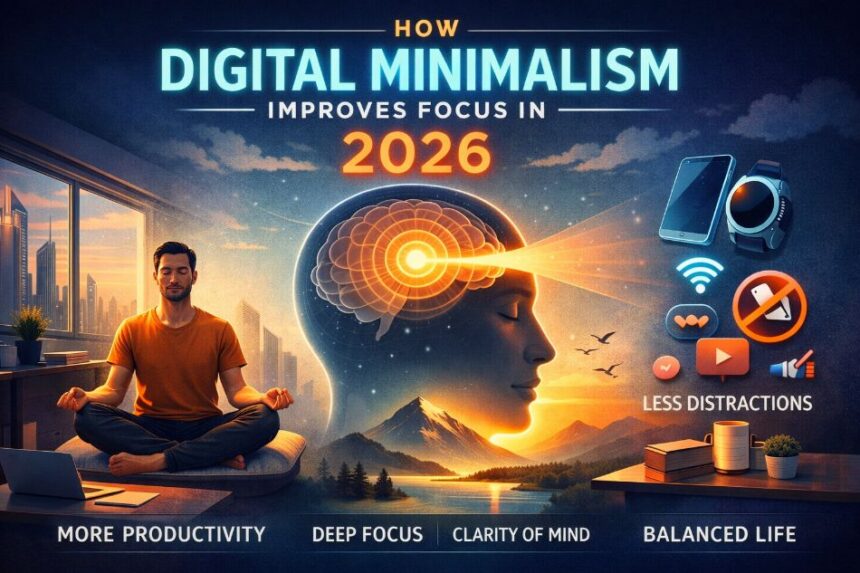
In the digital landscape of 2026, where notifications are more pervasive, interfaces more immersive, and demands on our attention more sophisticated than ever, the concept of digital minimalism has evolved from a niche lifestyle choice into a critical cognitive survival skill. Digital minimalism is a philosophy of technology use centered on the intentional and purposeful engagement with digital tools, rejecting the “more is better” approach in favor of a curated digital life that supports your values and goals. The core digital minimalism benefits are profound, chief among them being the radical improvement of one’s focus and depth of work. As we navigate an environment saturated with generative AI assistants, augmented reality feeds, and ever-present connectivity, understanding and applying digital minimalism principles is no longer optional for those seeking to produce meaningful work and maintain mental clarity.
The 2026 Attention Economy: Why Focus is the New Currency
The battle for your attention has intensified. Companies employ advanced neural interface research, hyper-personalized algorithms, and ambient computing to seamlessly integrate demands into every moment of your day. In this economy, your sustained focus is the ultimate commodity.
-
The Cost of Constant Context Switching: Neuroscientific research confirms that each ping, buzz, or notification triggers a cognitive shift. In 2026, the myth of multitasking has been彻底 dismantled; what we call multitasking is merely rapid, exhausting task-switching that increases cognitive load, reduces the quality of work, and elevates stress hormones.
-
The Illusion of Productivity: Tools marketed as productivity boosters often become portals to distraction. Without intention, a project management app becomes a source of anxiety, a communication platform a vortex of endless chatter, and a “smart” device an interruption factory.
-
Digital Clutter and Cognitive Load: Every unused app subscription, unread newsletter, and unchecked notification subconsciously occupies mental space, contributing to what is termed “attention residue” and decision fatigue before the workday even begins.
Defining Digital Minimalism for the Modern Age
Digital minimalism transcends simple digital detoxes. It is a sustained practice of:
-
Clarifying Your Values: Identifying what is profoundly important to you—deep work, family, creativity, health.
-
Auditing Your Technology: Evaluating each digital tool, platform, and subscription against those values. Does it significantly support them?
-
Optimizing Your Usage: Intentionally designing rules and protocols for how you engage with allowed technologies, prioritizing human-centric, focused interaction.
As noted by Inspirationfeed, this philosophy is increasingly adopted by high-performers across industries who recognize that a decluttered digital environment is the foundation of a decluttered mind.
The Direct Link: How Digital Minimalism Forges Unbreakable Focus
1. It Eliminates Decision Fatigue and Cognitive Drain
By radically simplifying your digital inputs, you conserve vital mental energy for the tasks that matter. A minimalist digital environment means fewer choices about what to check, which tab to open, or which app to use. This preserved cognitive capacity is directly redirected into sustained, deep focus on your priority projects.
2. It Creates Boundaries Against Interruption
Digital minimalists don’t just use technology differently; they build architecture against its intrusions. This involves:
-
Schedule-Based Checking: Allocating specific, limited times for email and messaging, rather than a perpetual “inbox zero” hunt.
-
Notification Neutering: Turning off all non-essential notifications. In 2026, the most focused individuals have their devices on “Essential Mode” 90% of the time.
-
Tool Singularity: Using one tool for one purpose effectively, rather than juggling multiple apps that promise the same function.
3. It Cultivates a State of “Deep Work” as the Default
Cal Newport’s concept of Deep Work—the ability to focus without distraction on a cognitively demanding task—is the pinnacle of productive focus. Digital minimalism is a prerequisite. By removing the constant low-grade dopamine hits of shallow interactions, you retrain your brain to find satisfaction in the challenging, rewarding flow of concentrated effort.
4. It Reduces Anxiety and Improves Mental Bandwidth
The endless scroll, the comparison culture fueled by social feeds, and the fear of missing out (FOMO) generate significant background anxiety. By decluttering these sources, digital minimalism alleviates mental static. A calmer mind has vastly more bandwidth for intentional, focused thought.
A 2026 Digital Declutter: Your Practical Action Plan
Implementing digital minimalism is an active process. Here is a step-by-step guide tailored for today’s environment.
Phase 1: The 30-Day Digital Audit
-
Define Your “Must-Have” Tools: List digital tools crucial for your work, loved-one connections, and essential services (e.g., banking). Everything else is optional.
-
Unsubscribe and Uninstall: For 30 days, remove optional apps from your phone and computer. Unsubscribe from all non-critical newsletters and promotional emails.
-
Log Your Usage: Use built-in digital wellbeing tools to honestly audit where your time goes.
-
Reintroduce with Intention: After 30 days, you may reintroduce an optional tool only if it provides a clear, significant benefit that aligns with your values.
Phase 2: Optimizing Your Core Technologies
-
Your Smartphone: Transform it into a “tool, not a toy.” Keep only essential apps on the home screen. Use grayscale mode to reduce visual appeal.
-
Your Computer: Practice single-tab browsing. Use website blockers during focused work sessions. Organize files with a minimalist, consistent system.
-
Your Communication: Set auto-responders to manage expectations. Advocate for asynchronous communication (e.g., Slack, email) over synchronous (instant messaging) where possible in your workplace.
Phase 3: Establishing Sustainable Protocols
Create personal rules, such as:
-
No devices during the first and last hour of the day.
-
All social media usage is confined to a 10-minute slot on a desktop computer.
-
“Focus Phones” (dumbphones or locked-down smartphones) are used during weekend retreats or creative sprints.
Digital Minimalism in 2026: Adapting to New Technologies
The principles remain constant, but the application evolves. In 2026, consider:
-
AI Assistants: Use them as command-line tools for specific outputs (“draft an email about X,” “summarize this article”), not as open-ended chatbots for entertainment.
-
Wearables & AR: Disable all non-health-related notifications. Use AR for specific, intentional tasks (learning, navigation), not as a persistent background layer.
-
The Metaverse & Immersive Spaces: Enter with a clear purpose and time limit. These are ultimate focus stealers if approached without intention.
The Quantifiable Benefits: A Focus Comparison Table
| Metric | High-Digital-Use Lifestyle (Default) | Digital Minimalist Lifestyle (Intentional) |
|---|---|---|
| Average Daily Focus Sessions | Frequent, short bursts (<20 mins) interrupted by notifications. | Fewer, longer deep work sessions (60-90 mins) of uninterrupted flow. |
| Cognitive Load | High. Mental resources are depleted by constant app switching and decision-making. | Low. Preserved for high-value tasks, reducing mental fatigue. |
| Quality of Output | Variable, often shallow, with higher error rates due to distraction. | Consistently higher quality, more creative, and with greater depth. |
| Stress & Anxiety Levels | Elevated due to FOMO, information overload, and perceived urgency. | Significantly reduced, leading to better sleep and overall well-being. |
| Recovery Time | Longer. Difficulty “switching off” due to blurred boundaries. | Shorter. Clear digital boundaries allow for true mental recovery. |
Conclusion: Your Focus is Your Future
As we move deeper into the decade, the ability to focus will become one of the most distinguishing and valuable skills in both professional and personal realms. Digital minimalism is the most effective operating system for cultivating that skill. It is a proactive, continuous practice of aligning your tools with your intentions. The digital minimalism benefits—unwavering focus, reduced anxiety, greater creativity, and recovered time- are not just productivity gains; they are foundational to a more intentional and fulfilling life in 2026 and beyond. Start your digital declutter today. Your attention is worth far more than you are being paid for it in likes, clicks, and scrolls. Reclaim it.