Introduction
In a world of relentless notifications and endless to-do lists, the ability to focus has become a rare commodity. Many seek complex solutions to combat scattered minds. However, psychological research points to a surprisingly humble antidote: the simple routine. The power of consistent rituals to sharpen concentration is deeply rooted in brain function. By automating decisions and creating predictable patterns, simple routines free up our most precious cognitive resources. This article explores the core psychological principles explaining why basic daily sequences can dramatically enhance mental clarity, reduce anxiety, and fortify our focus. Ultimately, understanding this mechanism is the first step to harnessing it, transforming daily life into a foundation for sustained attention.
The Cognitive Load Theory: Freeing Up Mental RAM
Our brains have a limited capacity for conscious thought, similar to working memory or mental RAM. Every decision we make, no matter how trivial, consumes a slice of this finite resource.
Simple routines work by automating sequences of behavior. When you follow a consistent morning routine, you transform a series of decisions into a single, automatic script. This process, known as chunking, moves the activity from the prefrontal cortex to the basal ganglia.
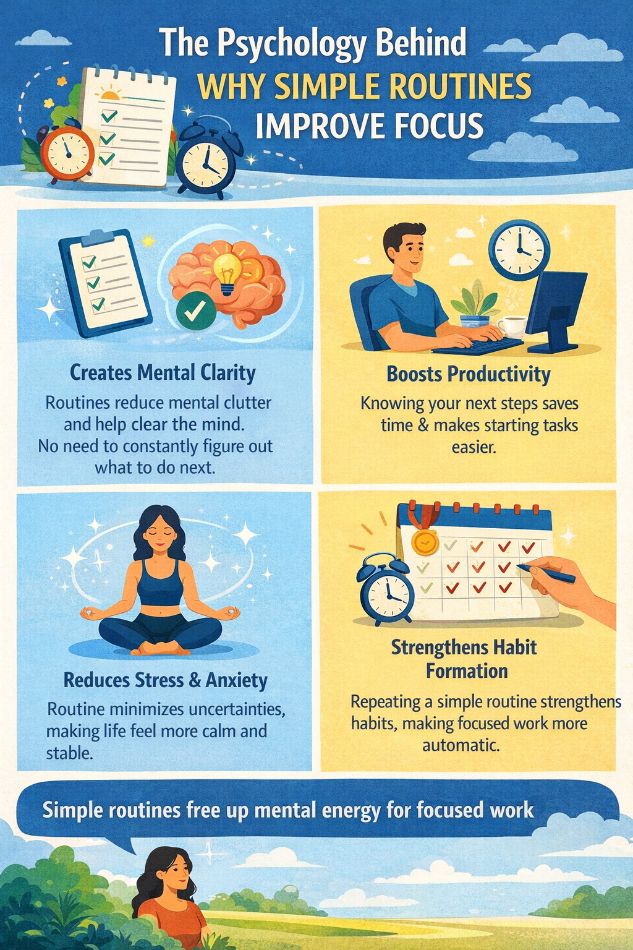
Consequently, this leads to a dramatic reduction in cognitive load. By eliminating dozens of micro-decisions, you preserve mental energy for tasks requiring deep focus. Your brain isn’t exhausted by trivial choices; it’s primed for important work. Therefore, simple routines improve focus by acting as a cognitive decluttering tool.
The Habit Loop and Predictability: Reducing Anxiety
Charles Duhigg’s Habit Loop concept includes a Cue, a Routine, and a Reward. Simple routines leverage this loop to create stability.
-
Cue: A specific time, location, or preceding action.
-
Routine: The pre-established sequence of behaviors.
-
Reward: The feeling of clarity and control.
This loop creates predictability, which is a powerful anxiolytic for the brain. Uncertainty triggers the brain’s threat detector and scatters attention. In contrast, a predictable routine signals safety, lowering stress hormones. As a result, a calmer brain is a more focused brain.
Furthermore, routines directly combat decision fatigue. This is the deteriorating quality of decisions made after a long session of choice-making. By routinizing parts of your day, you strategically conserve willpower for where it matters most.
Environmental Cues: Priming the Brain for Work
Our brains link environments with specific modes of thinking. Simple routines build powerful contextual cues that prime your brain for focus.
A pre-work ritual performed consistently tells your brain, “It is time to enter focused mode.” Over time, these actions become a psychological trigger. They shift your brain state automatically from “distracted” to “productive.”
This principle reduces the friction of starting a difficult task. The routine acts as a ramp, smoothly transitioning your mind into deep work without an internal struggle.
The Rhythm of Ultradian Cycles
Focus operates in natural cycles. Humans experience ultradian rhythms—90-120 minute periods of high alertness followed by periods of lower alertness. Effective, simple routines honor this biology.
The most focused individuals use routines as a structure that incorporates strategic renewal. For example, the Pomodoro Technique aligns with our neurology. A broader daily routine might schedule deep work for the morning and administrative tasks for the post-lunch dip.
Critically, a routine with scheduled breaks isn’t a distraction; it’s a tool to sustain focus. These breaks allow the brain to consolidate information and prevent burnout. Thus, a good routine systematically rebuilds your capacity to focus.
Building a Focus-Fortifying Routine: Key Principles
Understanding the psychology is one thing; applying it is another. Here’s how to build a simple routine that improves focus.
Start Small and Stack Habits
First, anchor your routine with one tiny, non-negotiable action. Consistency trumps complexity. Next, use habit stacking: link a new habit to an existing one. For instance, “After I pour my coffee, I will write my top three priorities.”
Design Your Environment and Reward Yourself
Additionally, make the cues for your routine obvious and distractions invisible. Charge your phone outside the bedroom, for example. Also, incorporate a clear reward. Initially, this might be tangible, but eventually, the focused state becomes the reward itself.
Maintain Flexibility
Finally, remember a routine is a framework, not a prison. Be flexible, not fragile. If you miss a step, simply resume at the next cue. The goal is overall progress, not perfect execution.
Conclusion
The quest for improved focus does not require more complexity; it demands intentional simplicity. The psychology is clear: simple routines improve focus by operating in harmony with our brain’s wiring. They reduce cognitive load and decision fatigue, create calming predictability, and leverage powerful contextual cues. A routine is cognitive scaffolding that supports peak mental performance. By investing discipline to establish automatic sequences, we buy back immense cognitive freedom. We become proactive architects of our own attention. The result is not just better productivity, but a calmer, more controlled, and mentally resilient mind. Ultimately, the path to profound focus begins with the quiet power of a simple, repeated ritual.
FAQs: Simple Routines and Focus
1. How long does it take for a new routine to improve focus?
While a simple routine can provide immediate cognitive relief by reducing decision-making, forming an automatic habit typically takes an average of 66 days. The key is consistency. You may notice a reduction in morning anxiety and easier task initiation within a week or two.
2. Can a routine be too rigid and stifle creativity?
A well-designed routine is a foundation for freedom, not a cage. Its primary role is to manage mundane tasks, liberating mental energy for creative work. Many renowned artists had strict routines to enable their creativity. Flexibility within the structure is essential.
3. I’m overwhelmed by digital distractions. Can a routine really help?
Absolutely. Building digital boundaries into your routine is one of its most powerful applications. Simple rituals like starting work with your “phone in another room on Do Not Disturb” act as a pre-commitment device. This protects your focus by reducing the willpower needed to resist distractions.
4. What’s a simple routine I can start with tomorrow?
Try a “Focus Priming” Morning Routine (under 15 minutes):
-
On waking: Drink a large glass of water.
-
Next: Make your bed for an immediate win.
-
Then: Spend 5 minutes writing your 1-3 most important tasks.
-
Finally, spend 5 minutes in mindful breathing.
This sequence sets a clear intention, priming your brain for a focused day.
5. Are routines effective for children to improve focus?
Yes, perhaps even more so. Children thrive on predictability, which reduces anxiety. A consistent after-school routine provides the structure their developing brains need. It teaches them to associate specific contexts with tasks, building self-regulation and focus skills critical for success.