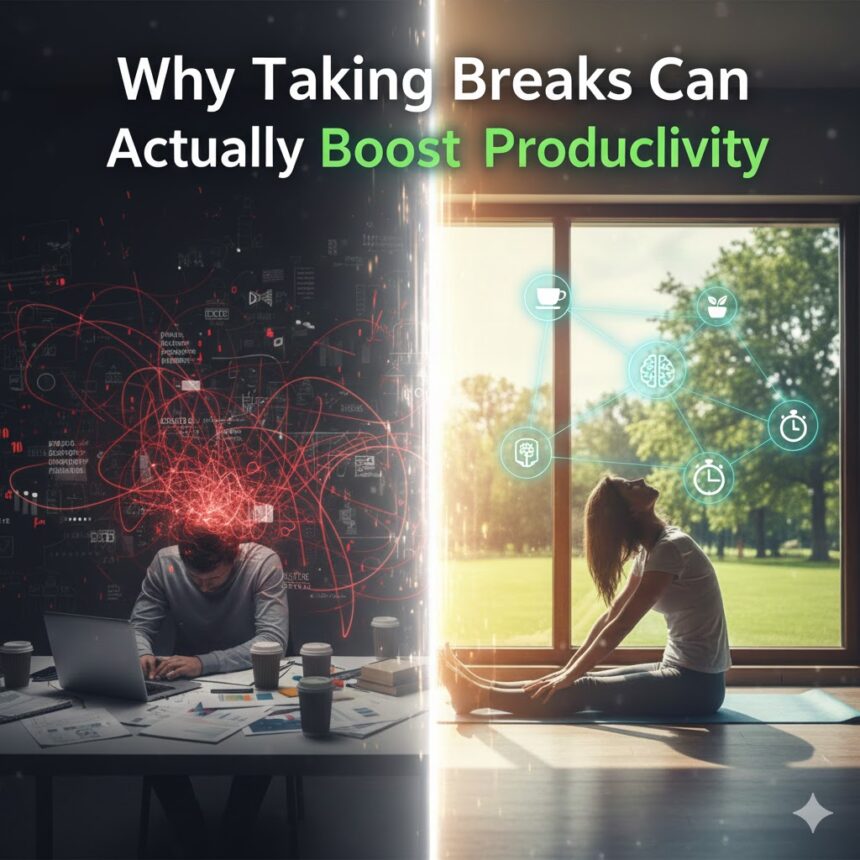
For decades, the prevailing cultural narrative equated productivity with relentless, uninterrupted work. The ideal worker was a marathoner, glued to their desk, powering through fatigue in a haze of coffee and willpower. However, a growing body of scientific research from neuroscience, psychology, and organisational behaviour is conclusively debunking this myth. The truth is far more counterintuitive: Strategically taking breaks is not a sign of slacking but a critical component of sustained, high-level productivity.
This article moves beyond the simple advice to “take a break” and delves into the why and how. We will explore the biological and cognitive mechanisms at play, provide a framework for implementing effective productivity breaks, and equip you with the knowledge to transform your work rhythm from one of diminishing returns to one of consistent renewal and output.
The Cognitive Science Behind Productivity Breaks
Our brains are not designed for the sustained, focused attention demanded by the modern knowledge economy. They operate in natural cycles of peak focus and necessary restoration. Ignoring these rhythms leads to cognitive depletion.
1. Combating Attention Fatigue and Decision Depletion
The prefrontal cortex, the brain’s executive centre responsible for focus, decision-making, and complex thought, has limited resources. Like a muscle, it fatigues with continuous use—a phenomenon termed “attention residue” or “decision fatigue.” Each time you switch tasks without a proper reset, residual thoughts from the previous task bleed into the new one, reducing efficiency.
-
The Role of Breaks: A deliberate break allows the prefrontal cortex to disengage and replenish its cognitive resources. This reset reduces mental clutter, restores willpower, and prepares the brain for a fresh bout of focused work.
2. The Role of the Default Mode Network (DMN)
When you are deeply focused on a task, your brain’s Task-Positive Network (TPN) is active. During periods of rest—when you daydream, take a walk, or simply gaze out the window—a different network, the Default Mode Network (DMN), lights up. Neuroscientists have discovered that the DMN is crucial for:
-
Consolidating Learning and Memory: It helps process and store information acquired during focused periods.
-
Creative Insight and Problem-Solving: The “Aha!” moment often arrives not when you’re grinding at a problem, but when you’re in the shower or on a walk. The DMN makes connections between disparate ideas subconsciously.
-
Building a Sense of Self and Future Planning: It underpins big-picture thinking.
-
The Role of Breaks: By stepping away from active work, you activate the DMN, unlocking creativity and strategic thinking that direct focus cannot achieve.
3. The Ultradian Rhythm: Your Body’s Natural Productivity Pulse
Human physiology operates on a 90-120-minute cycle called the Ultradian Rhythm. Within each cycle, we move from high alertness into a physiological downturn. Pushing through this natural low leads to stress, irritability, and a sharp drop in performance.
-
The Role of Breaks: Aligning short breaks with the end of these 90-120 minute cycles respects your biology. A break at the natural dip allows your body and mind to reset, ensuring you start the next cycle at a higher baseline of performance.
The Tangible Benefits of Implementing Productivity Breaks
The science translates into concrete, measurable advantages for individuals and organisations.
-
Enhanced Focus and Concentration: Regular breaks prevent the steady decline of attention, maintaining a higher average level of focus throughout the day.
-
Increased Creativity and Innovation: As discussed, DMN activation during breaks fosters novel connections and solutions.
-
Improved Memory and Learning: Breaks facilitate the consolidation of information from short-term to long-term memory.
-
Reduced Stress and Prevention of Burnout: Breaks lower cortisol levels, mitigates the physical and emotional exhaustion of chronic stress, and promotes psychological detachment from work.
-
Better Physical Health: Counteracting the harms of prolonged sitting, breaks encourage movement, reducing risks associated with a sedentary lifestyle, such as musculoskeletal issues and cardiovascular strain.
-
Sustained Motivation: The promise of an upcoming break can make a focused work session more manageable, using the break as a reward and maintaining overall motivation.
How to Structure Your Productivity Breaks for Maximum Impact
Not all breaks are created equal. Scrolling through social media for 10 minutes may feel like a break, but, can leave you more mentally fragmented. Here’s how to design effective productivity breaks.
The Micro-Break (5 minutes every 25-55 minutes)
Ideal for tasks requiring deep focus. The Pomodoro Technique (25 minutes work, 5-minute break) is a popular application.
-
What to do: Stand up, stretch, gaze at a distant object (to rest your eyes), take deep breaths, hydrate.
-
What to avoid: Checking email or social media.
The Macro-Break (15-30 minutes every 90-120 minutes)
Align with your Ultradian Rhythm. This is a true cognitive reset.
-
What to do:
-
Take a brisk walk outdoors (nature has added restorative benefits).
-
Engage in light, non-work-related conversation.
-
Practice a short mindfulness or meditation exercise.
-
Listen to music.
-
Have a healthy snack.
-
-
What to avoid: Work-related tasks or consuming stressful news/media.
The Meal Break (60 minutes)
A non-negotiable period for proper nourishment and mental detachment.
-
What to do: Eat away from your workstation. If possible, socialise or spend time in a different environment.
Comparing Break Strategies
| Break Type | Duration | Frequency | Primary Benefit | Ideal Activity Example |
|---|---|---|---|---|
| Micro-Break | 5 mins | Every 25-55 mins | Prevents attention fatigue, reduces physical strain | Stretching, hydrating, and deep breathing |
| Macro-Break | 15-30 mins | Every 90-120 mins | Cognitive reset, DMN activation, creativity boost | Walk outside, mindfulness, casual chat |
| Meal Break | 60 mins | 1-2 per day | Physical nourishment, psychological detachment | Eating lunch away from the desk, socialising |
| Movement Break | 5-10 mins | As needed | Combats sedentariness, boosts energy | Desk-based stretches, climbing stairs |
Overcoming the Cultural and Psychological Barriers
Despite the evidence, many resist taking breaks due to deeply ingrained beliefs.
-
The “Always On” Fallacy: Output is not linear to time spent. Three hours of focused, refreshed work can yield more than eight hours of fatigued drudgery. As research from Stanford University has shown, productivity per hour declines sharply when the workweek exceeds 50 hours.
-
The Guilt Factor: Reframe your thinking. A break is not time off from work; it is a productive, necessary part of the work process. You are “on” for your brain’s maintenance.
-
The Hyper-Connection Trap: The constant ping of notifications shatters focus and creates a false sense of urgency. Use breaks to disconnect from devices intentionally.
Implementing a Break-Friendly Culture
For leaders and teams, fostering an environment where breaks are normalised is crucial for collective productivity and well-being.
-
Lead by Example: Managers should visibly take breaks and encourage their teams to do the same.
-
Educate the Team: Share the science behind productivity breaks to align on the “why.”
-
Design the Environment: Create inviting break-out spaces that are separate from workstations.
-
Respect Protected Time: Avoid scheduling meetings over standard break or lunch periods.
-
Focus on Outcomes, Not Activity: Measure performance based on results and quality of work, not hours logged at a desk.
The science is unequivocal. Strategic disengagement is the partner to deep work. By understanding and harnessing the power of your brain’s natural rhythms through purposeful productivity breaks, you transform your workday from a draining sprint into a series of powerful, sustainable intervals. You cease to be a marathoner running on fumes and become a series of well-trained sprinters, each one fresh, focused, and capable of peak performance.
It is time to discard the outdated badge of honour awarded for non-stop work. The new paradigm of intelligent productivity champions the strategic pause. It recognises that to operate at our best, we must rhythmically engage and disengage, focus and rest, think and wander. Start by integrating one type of break into your tomorrow. Observe the difference in your energy, focus, and output. Your brain—and your results—will thank you. For more insights on optimising your performance and well-being, explore the resources available here at Inspirationfeed.
Further Reading & External Resources:
-
The National Institute for Occupational Safety and Health (NIOSH) discusses the importance of rest breaks for workplace health and safety.
-
Research published through the American Psychological Association explores the concept of cognitive resource depletion and recovery.